Skip to main content · 跳至主要内容
Knowledge Centre

Reading jewellery certificates responsibly

What a certificate can confirm, what it may not confirm, and how to check a report against the item in your hand.

What a certificate covers

What a certificate can confirm

What a certificate may not confirm

Laboratory name

Report number

Product description

Testing limitations

Reports by category

Jadeite treatment terminology

Diamond grading reports

Pearl reports

Verification and pitfalls

Report verification

Certificate substitution

Mismatched certificates

Checking the certificate together with the item

Understanding certification marks

What CMA, CNAS and ILAC MRA actually mean

The following marks are shown for educational explanation only. Lucky Jewellery does not claim to hold any of these accreditations; whether a given laboratory is entitled to display them should be verified through the relevant official registry.

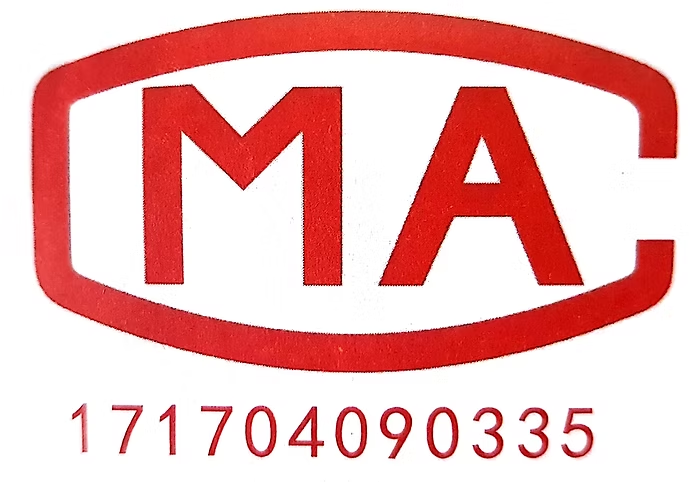
Educational illustration of the CMA accreditation mark
CMAAccreditation Mark

China Inspection and Testing Institution Qualification Accreditation

A Chinese statutory qualification confirming that a testing institution has been assessed and approved to carry out testing activities. The number printed beneath the CMA mark is the laboratory's own qualification approval number; it is unique to each institution and should be checked against the official registry. The number shown in the illustration above is for educational demonstration only.

What to verify
  • The institution's full legal name
  • The number printed below the CMA mark — this is the laboratory's unique qualification approval number, and it differs from one institution to another. Verify it against the official registry.
  • The certificate is issued within the approved testing scope
  • The report matches the item being sold
Common misunderstandings

CMA alone does not automatically mean a laboratory is unreliable, nor does it guarantee every individual test conclusion is correct.
Educational illustration of the CNAS accreditation mark
CNASAccreditation Mark

China National Accreditation Service for Conformity Assessment

CNAS is a laboratory accreditation / qualification mark. It confirms that a laboratory has been assessed as technically competent to carry out specific tests within a defined scope. It is an assessment of the laboratory, not a guarantee of any single test result. The mark shown here is for educational illustration only and does not indicate that any particular laboratory is authorised to use it.

What to verify
  • Laboratory name
  • Accreditation number
  • Current accreditation status (valid, suspended or withdrawn)
  • Whether jewellery and gemstone testing is included in the recognised scope
Common misunderstandings

CNAS accreditation does not automatically extend to every project the laboratory offers; it only covers the items within the recognised scope.

Educational illustration of the ILAC MRA accreditation mark
ILAC MRAMutual Recognition

International Laboratory Accreditation Cooperation — Mutual Recognition Arrangement

ILAC MRA is an international laboratory accreditation / mutual-recognition mark. It indicates that an accreditation body is a signatory to the ILAC Mutual Recognition Arrangement, and that laboratories accredited by that body may use the combined mark within their recognised scope. ILAC itself does not test gemstones or issue jewellery certificates. The mark shown here is for educational illustration only and does not imply that any specific body or laboratory is authorised to use it.

What to verify
  • The mark shown here is for educational illustration only; the actual mark on a certificate should be checked against the official ILAC signatory records
  • The accreditation body itself is an ILAC MRA signatory
  • The combined mark is used by an accreditation-body-entitled laboratory
  • The specific report falls within that laboratory's recognised scope
Common misunderstandings

An ILAC-related combined logo on a certificate does not, by itself, prove the laboratory is competent for the specific test shown on the report.

QR codes

What a QR code can and cannot prove

Any organisation can build its own website and certificate-lookup system. A QR code that opens a page is not, on its own, evidence of official accreditation or of a correct test result.

A QR code can prove
  • A certificate lookup page exists on some website.
A QR code does NOT automatically prove
  • That the issuing laboratory is officially accredited.
  • That any accreditation mark shown is genuinely authorised for that laboratory.
  • That the accreditation scope actually includes jewellery testing.
  • That the technical conclusion in the report is correct.
  • That the certificate belongs to the exact item you are looking at.
Checklist

How to check whether a jewellery certificate is reliable

Competence, authorised scope, test method, institution identity and item-matching should be checked together — no single mark or QR code can replace this joined-up check.

  1. 01Verify the institution's full legal name.
  2. 02Verify the accreditation number through an official registry.
  3. 03Check the laboratory's recognised testing scope.
  4. 04Confirm the official website domain before scanning any QR code.
  5. 05Compare product photo, weight, colour, shape and certificate number with the item.
  6. 06Confirm the certificate belongs to the exact item being sold.
  7. 07Be cautious of logos that only resemble CMA, CNAS or international accreditation marks.
Our position

How Lucky Jewellery reads a certificate

Lucky Jewellery does not assess a certificate only by the number of logos printed on it. We consider the testing institution, its official accreditation status, its recognised testing scope, the details of the certificate itself, and whether the document corresponds to the exact jewellery item in front of you.